

They say the best things come in small packages. And when it comes to fitness, nothing proves that point quite like the Pilates loop band. Interestingly, most of us assume that real progress only happens in a gym packed with big machines and chunky dumbbells.
A compact set of elastic bands can help you train consistently, build strength, and keep workouts interesting wherever you are. They’re easy to pack or keep at your desk, and a set of resistance loops can still make a meaningful difference in how you move and feel.
If you’re traveling, working long hours, or short on equipment, resistance loop bands make it easier to fit in a session without compromising intensity. Adding Pilates band exercises to your routine can also help you “find” the muscles you’re trying to target, especially the glutes, while staying joint-friendly.
Why Add Bands to Your Pilates Routine?
If your workouts have started to feel repetitive, your body may have adapted to the same patterns. Pilates, at its simplest, can be amazing for posture and core strength. But when you add resistance loop bands, it can turn things up a notch.
This one piece of portable Pilates equipment pushes your muscles to adapt and tone up fast.
Here’s why this tiny tool makes such a big difference:
Constant Tension
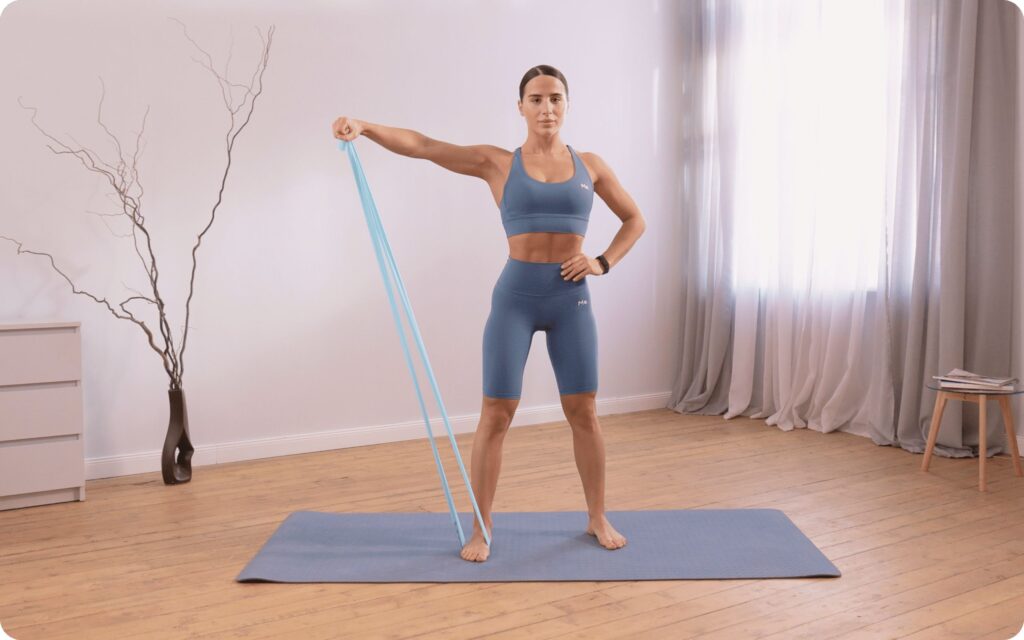
With free weights, there are moments when tension decreases, especially at the top or bottom of a rep. Bands don’t allow that. Resistance loop bands keep your muscles working from start to finish, both on the pull and the release. This kind of nonstop tension helps create that long, lean Pilates look without adding bulk.
Better Glute Engagement
If your quads tend to dominate during lower-body work, you’re not alone. Pilates bands help cue the glutes by creating outward resistance. Place a loop band just above your knees during lower-body exercises and you’ll immediately feel the side glutes (gluteus medius) working to stabilize and control movement.
Gives a Full Body Workout
This portable Pilates equipment isn’t specified for leg exercises only. Move it from ankles to wrists in seconds. Use it to add resistance to tricep presses, level up bicycle crunches, or support back extensions for better posture and mobility.
Doesn’t matter if you’re at home, in a hotel, or outside in your backyard, resistance loop bands make sure every workout counts. Pilates bands are also one of the most practical forms of portable Pilates equipment: light, simple, and versatile.
Fabric vs. Latex: Does Material Matter?
Material makes a bigger difference than most people expect, especially when you’re using bands for lower-body strength and a glute workout with bands. Latex and rubber bands can work well for mobility and lighter resistance, but they’re not always the most comfortable choice for higher-rep strength work. They can stick to sweaty skin, pinch during movement, roll up on the thighs, or wear out faster if the material is thin.
Fabric Pilates loop bands are often preferred for strength-focused training because they tend to feel more stable on the body. They’re typically wider, less likely to roll, and more comfortable against skin or leggings so you spend less time adjusting your band and more time moving with control.
| Feature | Latex/Rubber Bands | Fabric Loop Bands |
| Durability | Prone to snapping and tearing over time. | Heavy-duty weave and built to last. |
| Comfort | Can pinch skin and pull leg hair. | Soft, clothing-like feel without any pinching. |
| Stability | Known to roll up or slide during movement. | Stay-put grip technology, it never rolls. |
| Resistance | Usually light to medium, it can feel flimsy. | Consistent, strong resistance for the glutes. |
If you’re done stopping every thirty seconds to fix a rolling rubber band, it’s time to upgrade. High-quality fabric Pilates bands stay put, won’t snap mid-set, and give you a steady resistance. As a result, you can experience better glute and leg activation with zero distractions.
3 Moves to Try with Your Bands
Do you want to maximize the benefits of the resistance bands you invested in?
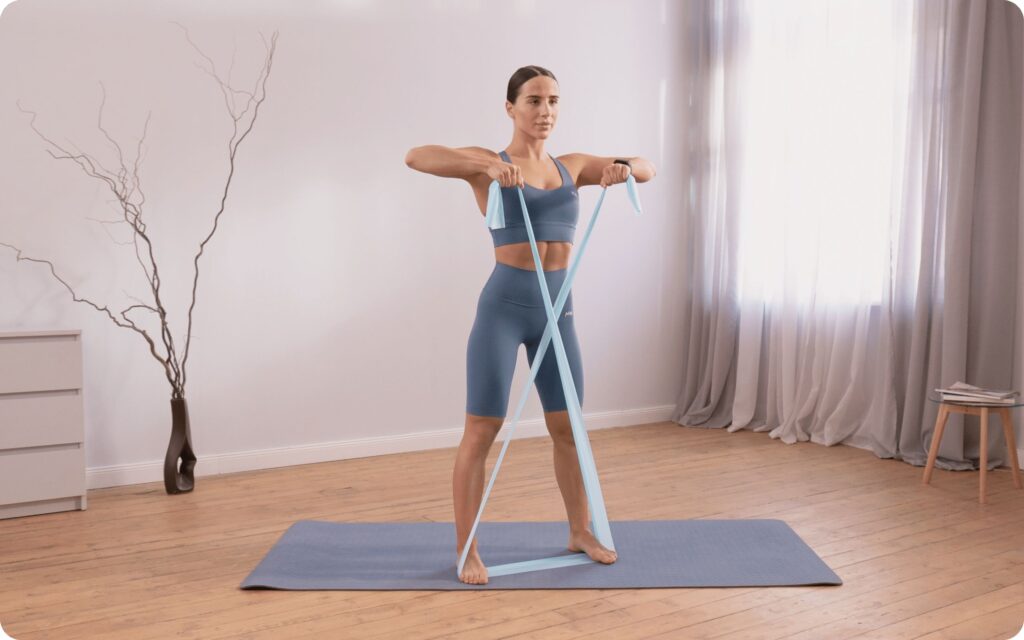
You don’t need a long session to feel it. These three moves hit your glutes, hips, and core fast. Do each move for 45 seconds, rest 15 seconds, and repeat for 3 rounds.
Move # 1: Banded Bridge
Setup: Lie on your back. Place the band a few inches above your knees. Feet stay hip-width apart.
Steps
- Press through your heels to lift your hips.
- At the top, gently push your knees outward against the band.
- Lower with control and repeat.
Move # 2: Clamshells
Setup: Lie on your side with knees bent and stacked. Place the band just above your knees.
Steps
- Keep your feet together.
- Lift your top knee without rolling your hips back.
- Lower slowly and repeat.
Move # 3: Squat with Pulse
Setup: Stand with feet shoulder-width apart. Position the band above your knees.
Steps
- Lower into a squat with your chest up.
- At the bottom, pulse your knees outward three times,
- Then, stand back up.
It may take a few days for you to learn the right form, but once you do it, every rep you do will bring you closer to your fitness goals!
Taking Your Workout Anywhere
Pilates bands are designed for real life. They don’t need a dedicated gym floor or a heavy rack to be effective. And considering that they are virtually weightless and take up less room than a pair of socks, they are the ultimate travel companion for the frequent flyer or the busy professional.
It doesn’t matter if you’re fitting in a quick workout in a hotel room or doing a glute session with bands at the park. These tools make sure your fitness goals never take a vacation just because you do.
You don’t need heavy weights or a full gym setup to build strength and tone. Pilates bands create steady resistance, help you stay engaged through each rep, and make workouts more adaptable, especially when space and time are limited.
If you want a simple way to make mat work more challenging and keep training on the go, add a set of resistance loop bands to your routine and use them consistently. A small tool can make your workouts feel more targeted, more effective, and easier to maintain anywhere.